
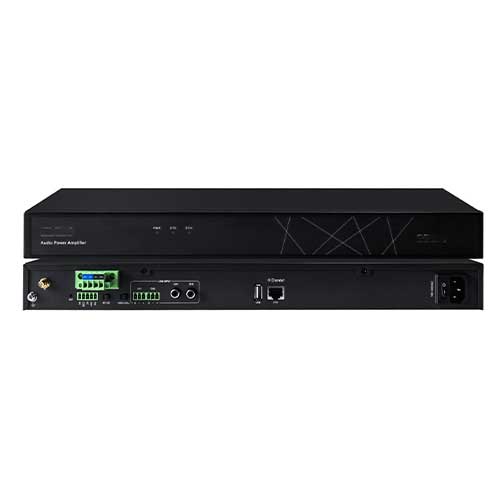

Amplifier: Network Amplifiers for Warehouses, Manufacturing & Business Facilities
Reliable Audio Communication Systems That Scale Across Your Entire Facility
Network amplifiers solve a key problem in large facilities: delivering clear, uniform audio everywhere. In warehouses, manufacturing campuses, or shipping centers, older audio systems regularly create dead zones, require expensive cabling, and deliver unreliable performance. Amplification boosts signal strength to ensure sound reaches all intended areas clearly.
IP-based network power amplifiers remove these problems by sending audio over Ethernet. Rather than running analog cables to each zone, simply connect amplifiers to your network with one Ethernet cable run and then cable off the amplifier.
Every audio system needs an amplifier, whether built-in or separate, to deliver clear sound. Emergency announcements reach everyone at once. Shift change bells trigger automatically. Background music and paging work without static or signal loss found in older systems.
Why You’ll Love Audio Power Amplifiers in Network Systems
- Instant Facility-Wide Communication – Communicate instantly with every employee across multiple buildings and floors. Network multicast makes certain that announcements reach all zones simultaneously, so critical messages are received in noisy production areas and remote loading docks.
- Cost-Effective Scalability – Easily add new zones by connecting additional amplifiers to your network. Eliminate the need for trenching, cable pulling, or costly rewiring when your facility expands.
- Emergency-Ready Reliability – Event scheduling and USB storage keep preloaded emergency messages ready for immediate playback. When time is critical, your system responds without delay.
- Simple Network Integration – Integrate smoothly with your existing Ethernet infrastructure. SIP protocol support provides direct connection to VoIP phone systems, while Dante compatibility enables professional audio networking.
- Professional Audio Quality – Class D amplifier technology delivers clean, distortion-free sound even at high volume. 0.05% THD+N means voice announcements remain intelligible in noisy industrial environments. Amplifier performance can vary depending on the signal type, such as speech or music, as each requires different power output, duration, and dynamic range.
Choosing the right amplifier involves coordinating the power and impedance to your speakers and making sure there are enough inputs for all audio sources. Amplifiers should also be selected for their ability to deliver high efficiency and low distortion for ideal audio performance.
What Makes Network Amplifiers Different
Traditional amplifiers have downsides: long cables degrade sound quality, adding zones is costly, and managing units requires more manual work. Emergency and daily systems are often separate, making maintenance harder. Output circuit design and resistor use add complexity.
Network amplifiers are built differently:
- IP-Based Distribution – Audio travels as data packets over Ethernet. No signal weakening over distance. No heavy gauge cables. No analog noise pickup from electrical equipment.
- Centralized Management – Control all zones from a single web interface. Adjust volume, configure EQ profiles, schedule automated announcements, and monitor system status without leaving your desk.
- Network amplifiers support multiple network channels. Local USB playback and backup power keep vital announcements going during outages.
How Network Amplifiers Work to Deliver an Output Signal
Step 1 – Network Connection
Connect the amplifier to your existing Ethernet switch using a standard RJ-45 cable. The electronic device receives an IP address and appears on your network immediately. No special adapters or interface cards required. The amplifier features two input terminals for applying the signal to be amplified, making sure that audio sources are properly received and processed.
Step 2 – Zone Configuration
Access the web-based interface to configure audio zones. Assign different areas—warehouse floors, offices, loading docks, break rooms—to specific channels. Set up input priorities so emergency announcements override background music automatically. During setup or troubleshooting, a test signal can be applied to verify system performance and guarantee correct operation.
Step 3 – Centralized Control
Manage all announcements and schedules from one location. The built-in event scheduler automatically triggers bells, shift changes, and safety reminders. The real-time mixer balances multiple input sources.
Types of Amplifiers
Amplifiers are key in any audio system. Understanding types helps managers pick the right one based on the operation and how they manage input and output signals.
Class A amplifiers: run the input signal through its entire cycle to minimize distortion, but are inefficient and create heat. They’re less suited to large-scale or high-power use in warehouses.
Class B amplifiers: split the signal to improve efficiency, though they can cause distortion.
Class AB blends: Class A’s sound quality with Class B’s efficiency, fitting most commercial audio needs.
Class C Amplifiers: Designed primarily for radio frequency (RF) applications, class C amplifiers operate with a conduction angle of less than 180 degrees. This means the amplifying device is active for only a small portion of the input signal, resulting in very high efficiency yet significant distortion, making them inappropriate for audio power amplifiers used in PA systems or facility sound distribution.
Class D Amplifiers: Class D amplifiers use fast on/off switching of transistors for efficient, low-heat amplification, allowing compact, high-power units. They suit modern facility audio by delivering clean sound, high efficiency, and reliable operation across zones.
Operational amplifiers are versatile for signal conditioning and control, important in preamp stages but not as main power amps.
Specialized Amplifiers: Other types include video amplifiers for playback and display systems, and multi-channel amplifiers supporting four or more channels for intricate audio zoning. Each delivers unique features—such as voltage gain, current gain, output resistance, and power gain—suited to different signals and applications.
Through understanding the classes, facilities can choose amplifiers that meet their needs—whether focusing on quality, efficiency, or coverage in loud spaces.
ASD260 vs ASD2140 Network Amplifier Comparison
While both Apex American Audio network power amplifiers share key professional features—Class D efficiency, SIP and Dante™ protocol support, Bluetooth 5.3 connectivity, and web-based management—the ASD260 and ASD2140 are differentiated by power output and the scale of facility they are designed for. ASD260 is optimized for moderate power needs and smaller areas, while ASD2140 is designed for high-power demands and larger or noisier environments
ASD260 | ASD2140 | |
SE Output Power | 2 × 60W @ 100V | 2 × 140W @ 100V |
BTL Bridged Output | 1 × 120W | 1 × 280W |
Frequency Response | 20Hz – 20kHz ±0.25dB | 20Hz – 20kHz ±0.25dB |
THD+N | 0.05% | 0.05% |
Signal-to-Noise Ratio | 85dB | 85dB |
Network Protocols | SIP, Dante™, ONVIF | SIP, Dante™, ONVIF |
Audio Inputs | Balanced Line, RCA, Bluetooth, Network | Balanced Line, RCA, Bluetooth, Network |
Speaker Configuration | 100V, 25V, or 4Ω minimum | 100V, 25V, or 4Ω minimum |
Built-in DSP | 10-band EQ, Real-time Mixer | 10-band EQ, Real-time Mixer |
Scheduled Playback | USB Storage + Event Scheduler | USB Storage + Event Scheduler |
Ideal Facility Size | Small-to-medium zones | Large zones, high-noise areas |
ASD260: Power Efficiency for Standard Zones
The ASD260 delivers 2 × 60 watts single-ended or 120 watts bridged. This amplifier boosts signals to drive speakers effectively. Using transistors, the ASD260 sets the standard for modern designs. The dual-channel output stage serves two zones from a single unit, covering more area with fewer devices. The output voltage reaches 24 V RMS per channel in most institutional speaker deployments.
Best applications: Indoor facilities up to 10,000 square feet, areas with moderate ambient noise, and multi-zone configurations demanding flexibility.
ASD2140: High Power for Demanding Environments
The ASD2140 produces 2 × 140 watts per channel or 280 watts bridged—more than double the ASD260’s output. This power amplifier makes use of advanced transistor amplifiers to achieve high output levels. The current flow through the amplifier’s output stage is optimized for efficiency in high-load environments. It drives high-SPL horn speakers in loud production areas, covers large, open-floor manufacturing spaces, and reaches outdoor loading docks where ambient noise from forklifts and equipment demands greater volume.
Best applications: Large facilities exceeding 10,000 square feet, high-noise industrial environments, outdoor paging zones, and spaces requiring maximum coverage.
Choosing the Right Model
Select the ASD260 when your facility has multiple smaller zones and moderate ambient noise levels. The improved efficiency, with lower power draw, makes it cost-effective for distributed installations. In many amplifier designs, a common emitter stage is used to provide voltage and power amplification, ensuring reliable performance.
Additionally, operational amplifiers may be used in the preamp or signal conditioning stages to ensure optimal input signal quality.
Select the ASD2140 when you need to overcome high ambient noise, cover large open areas, or drive outdoor horn speakers. The higher voltage gain and power output ensure announcements remain intelligible even within challenging sonic environments created by forklifts, conveyors, and machinery.
Product Details - ASD260
Power Requirements
- AC mains input voltage (verify local specifications)
- Standard power supply connection
- Non-PoE powered (requires a dedicated AC circuit)
Network Connectivity
- RJ-45 Ethernet connection
- 10/100/1000 auto-negotiation
- SIP protocol support (G.722, G.711 A/U, Opus codecs)
- Dante™ digital audio networking
- ONVIF integration for building management systems
Audio Specifications
- Frequency response: 20Hz – 20kHz ±25dB
- THD+N: 0.05% (ultra-low distortion)
- Signal-to-noise ratio: 85dB
- Constant-voltage output: 100V, 75V, 25V configurations
- Constant-impedance output: 4Ω minimum load
- The amount of amplification provided by an amplifier is measured by its gain, which is the ratio of the output voltage, current, or power to the input.
Inputs and Connectivity
- Balanced line inputs (2 × 3-pin Phoenix connectors)
- Unbalanced inputs (2 × RCA)
- Bluetooth 5.3 with external antenna
- Network audio via Ethernet
- It can be used for a variety of applications, including guitar amplification in certain setups and standard audio amplification.
Environmental Ratings
- Designed for indoor commercial and industrial operation
- Adequate ventilation is required for continuous high-power operation.
- Pair with IP65-rated speakers for outdoor or dusty environments
Installation Requirements
- Dimensions (ASD260): 440mm × 170mm × 44mm
- Weight (ASD260): 2.75kg
- Rack-mountable configuration
- Clearance required for ventilation and cable access
Warranty and Support
- 3-year manufacturer warranty
- Lifetime technical support and training
- Pre-configuration available before shipping
Historically, before the development of modern electronic amplifiers, relays were used as electromechanical amplifiers to boost signals over long distances in telegraphy and early telephony systems.
Who Network Amplifiers Are For
Ideal for:
- Manufacturing plant supervisors managing multi-shift operations who need dependable communication across production floors
- Warehouse managers oversee logistics across large facilities with multiple loading docks and storage areas.
- Facilities directors oversee campus-wide communication systems spanning multiple buildings.
- Safety officers require emergency notification systems that meet code compliance for intelligibility and coverage.
- Operations directors pursuing scalable audio systems that grow with facility expansion
If you want professional-grade audio distribution that operates reliably in demanding industrial environments, these network amplifiers are a good fit.
Frequently Asked Questions
Units ship pre-configured with your specifications, reducing on-site setup time. The web-based interface directs zone configuration, input priority, and scheduling. Professional installation support ensures proper speaker wiring and network integration. Most facilities are operational within hours of mounting the hardware. During installation or troubleshooting, a test signal can be applied to verify system performance.
Yes. Balanced and unbalanced line outputs feed legacy analog PA equipment. Constant-voltage speaker lines (70V/100V) connect directly to current distributed speaker systems. SIP protocol support integrates with VoIP phone systems for paging from any handset.
Multiple failsafe options preserve operation. USB storage holds preloaded emergency messages for local playback via the event scheduler. Analog line inputs provide backup audio sources. Network infrastructure best practices—redundant switches, backup power, multiple network connections—further protect critical communication.
Lifetime technical support and training ensure your team operates the system confidently. The 3-year warranty covers hardware issues. Pre-configuration before shipping reduces on-site complexity. Remote assistance helps troubleshoot any integration obstacles.
Single-ended (SE) operation runs both channels independently—ideal for serving two separate zones. A bridge-tied load (BTL) combines both channels into a single high-power output, effectively quadrupling the available power to a single zone. Use BTL mode when driving large speaker arrays or overcoming high ambient noise.
Class D amplifiers use switching output transistors rather than linear operation, achieving high efficiency (90%+) with minimal heat generation. Amplification in modern amplifiers is accomplished using transistors, which have replaced vacuum tubes in most designs.
Most amplifiers are designed to be linear, providing constant gain for any normal input level and output signal. Negative feedback is used in most modern amplifiers to increase bandwidth, reduce distortion, and control gain; this works by feeding part of the output back to the input in the opposite phase, subtracting from the input. This means smaller enclosures, lower power consumption, and reduced cooling specifications compared to class A amplifiers or class AB designs. The amplifier circuit maintains excellent audio performance while operating more efficiently.
Ready to Upgrade Your Facility Communication?
Stop dealing with dead zones and unreliable announcements that leave employees uninformed during critical moments. Stop accepting the noise, static, and signal weakening of outdated analog systems.
Choose network amplifiers and experience facility-wide audio sharpness that scales with your operation.
Pre-configuration included. Fast shipping. 3-year warranty. Lifetime technical support.